



Harnessing the Sun: Unveiling the Longevity of Solar Panels
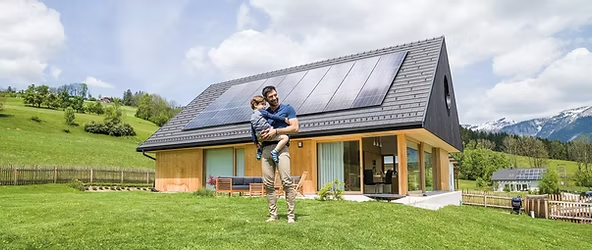
As the global shift toward renewable energy accelerates, rooftop solar has transitioned from an alternative environmental choice into an essential financial strategy for Australian households and businesses. If you are looking to insulate your property from volatile electricity grid prices, investing in a high-efficiency solar system is incredibly rewarding.
However, because a solar array is a significant long-term property investment, a vital question naturally arises: how long do solar panels last?
Understanding the operational lifespan, structural degradation characteristics, and warranty frameworks of modern photovoltaic (PV) hardware is crucial to maximizing your clean energy return on investment (ROI). Here is a practical, data-driven look at the longevity of modern solar technology under harsh Australian conditions.
The Core Factors That Determine Solar Panel Lifespan
Modern engineering has made rooftop solar arrays exceptionally durable. Unlike traditional power-generation hardware, solar PV systems have no moving parts, which drastically reduces mechanical wear and tear.
Instead, a system's true operational endurance comes down to structural material choices and engineering execution:
1. Premium Materials and Environmental Resilience
The front outer glass layer of a solar module serves as its primary shield against intense environmental elements. Premium panels utilize specialized, anti-reflective, tempered glass engineered to be highly impact-resistant against extreme weather events like severe storms and heavy hail.
A durable front pane prevents microscopic surface scratches and structural micro-cracks. Keeping this outer layer pristine ensures maximum light penetration reaches the underlying silicon photovoltaic cells, sustaining peak power output decade after decade.
2. Adherence to Tier-1 Manufacturing Standards
How a panel is constructed matters just as much as the raw materials used. Leading tier-1 solar manufacturers deploy fully automated fabrication lines that utilize strict thermal sealing and heavy-duty encapsulation frameworks.
This level of manufacturing precision prevents moisture ingress, internal corrosion, and premature delamination—the leading causes of premature system failures in cheaper, unbranded modules.
Understanding Solar Panel Degradation Rates
It is important to clarify a common misconception: solar panels do not simply stop working when they reach a certain age. Instead, they experience a very slow, highly predictable reduction in electrical efficiency over time, a process known within the industry as the solar panel degradation rate.
Thanks to major breakthroughs in N-type silicon cell architecture (such as TOPCon and HJT technologies), modern premium panels degrade at an incredibly slow rate:
[Year 1 Operational Peak] ➔ [~0.4% Annual Efficiency Drop] ➔ [85%+ Output at Year 25]
While budget panels from a decade ago degraded at roughly 0.8% to 1.0% per year, today's premium residential solar modules typically lose only 0.25% to 0.4% of their original generating capacity annually. This means that even after 25 years of continuous exposure to the Australian sun, a top-tier panel will still reliably produce over 85% of its day-one rated power output.
Performance vs. Product Warranties: What to Look For
When evaluating how long a clean energy system will last, it is essential to distinguish between the two separate warranties provided by manufacturers:
-
The Product Warranty: Covers physical defects, manufacturing flaws, and premature component breakdown. While the historical industry standard was 10 to 12 years, premium tier-1 brands now confidently provide 20 to 25-year product warranties.
-
The Performance Warranty: Guarantees the explicit power output of the panel over time, acting as a manufacturer-backed promise regarding the maximum allowable degradation curve (e.g., guaranteeing at least 87.4% output at the 25-year milestone).
Essential Maintenance Practices for Maximum Longevity
While a premium renewable energy asset requires very little day-to-day management, a proactive solar system maintenance routine can easily extend its productive lifespan beyond 30 years:
-
Scheduled Visual Inspections: Periodically check your roof to ensure overhanging tree branches aren't casting safe localized shadows or physically rubbing against the array's surface.
-
Professional solar cleaning: Accumulated atmospheric dust, coastal salt crusts, and organic bird droppings create localized cell shading. Getting your system washed down once or twice a year restores lost efficiency and prevents hot-spot thermal stress.
-
Electrical Inverter Health Checks: While your panels can easily push past 25 years of service, standard string inverters generally have a working lifespan of 10 to 12 years. Budgeting for a mid-life inverter refresh or switching to a decentralized microinverter platform ensures your system's uptime remains uncompromised.
Secure a Future-Proof Energy System with Electrifying Australia
Investing in rooftop solar is an excellent way to secure energy independence, but your long-term return depends entirely on the design and build quality of your system. Substandard hardware and hurried installations frequently lead to premature water ingress and voided manufacturer warranties.
At Electrifying Australia, we safeguard your investment by exclusively deploying fully certified, tier-1 solar technology tailored to withstand the Australian climate. Backed by our proud 4.95-star customer review rating, our specialized engineering team designs every array for maximum durability, optimal orientation, and long-term financial yield.
Subscribe to get special offers & updates.
Go To Top
142 Gipps Road, Smithfield, Sydney, 2164
1800 788 638
info@electrifyingaustralia.com.au


Electrifying Australia acknowledges Aboriginal and Torres Strait Islander peoples as the Traditional Custodians of the land on which we operate. We pay our respects to Aboriginal and Torres Strait Islander Elders past, present, and emerging.